Most business owners use cloud computing every day, through email, file storage, or accounting software, without ever thinking of it as “cloud computing.” The term sounds abstract mainly because the infrastructure behind it is deliberately invisible. That invisibility is the whole point, but it also makes the concept harder to explain than it needs to be.
This guide breaks down what cloud computing actually is, how it works, the main types of cloud services, and why it matters for a growing business.
Quick Answers
What is cloud computing, in simple terms?
It’s using computing power, storage, or software that runs on someone else’s servers over the internet, instead of buying and maintaining your own physical hardware.
Is cloud computing the same as “the internet”?
No. The internet is the network that connects everything. Cloud computing is a specific way of using that connection to access computing resources on demand, rather than something built into a device you own.
Is my data safe in the cloud?
It can be, often more so than on a small business’s own hardware, since major cloud providers invest heavily in encryption, access controls, and physical security most individual businesses could not replicate on their own.
Do I need to understand cloud computing to run my business?
Not in technical detail, but a basic understanding helps when evaluating software vendors, planning IT budgets, or discussing infrastructure with a development partner.
What Is Cloud Computing?
Cloud computing is the delivery of computing resources, such as servers, storage, and databases, over the internet by a provider like Amazon Web Services (AWS), Google Cloud, or Microsoft Azure, instead of a business owning and maintaining that hardware itself.
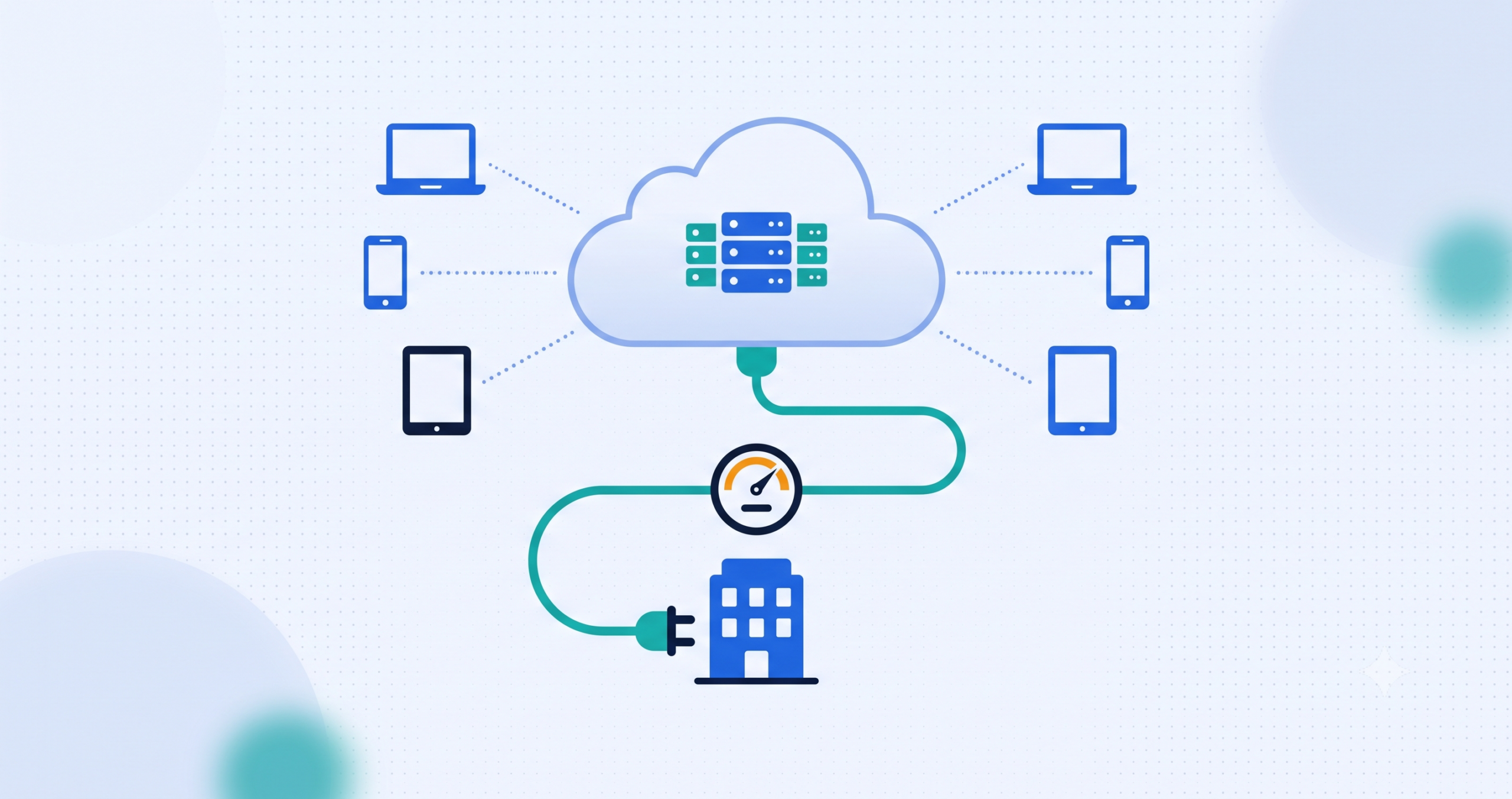
A useful comparison is electricity. Most businesses don’t generate their own power; they connect to a shared utility and pay for what they use. Cloud computing works the same way for computing resources: instead of buying servers and maintaining a server room, a business “plugs in” to a provider’s infrastructure and pays based on usage.
How Cloud Computing Works
- Providers maintain the physical infrastructure. Companies like AWS and Google Cloud operate large data centers full of servers, so individual businesses don’t have to.
- Businesses rent capacity as needed. Storage, processing power, and databases are accessed over the internet rather than purchased as physical equipment.
- Billing is usage-based. Costs scale with what is actually consumed, rather than a large upfront hardware purchase.
- Access works from anywhere. As long as there’s an internet connection, cloud-based systems can be reached from any location or device.
The Three Main Types of Cloud Services
| Type | Managed by the Provider | Managed by You | Example |
|---|---|---|---|
| IaaS (Infrastructure as a Service) | Physical hardware, networking | Operating system, applications, data | Raw cloud servers |
| PaaS (Platform as a Service) | Hardware, operating system, runtime | Just your application code | Managed app hosting platforms |
| SaaS (Software as a Service) | Everything | Just your usage and data | Email, video calls, subscription software |
Most business owners already use SaaS daily, tools like email, video calls, or accounting software, without thinking of it as “cloud computing” at all. It’s the same underlying concept, just with everything handled on the provider’s side.
Public, Private, and Hybrid Cloud
- Public cloud. Shared infrastructure across many customers, the most common and cost-effective option, offered by providers like AWS, Google Cloud, and Azure.
- Private cloud. Dedicated infrastructure used by a single organization, offering more control at a higher cost.
- Hybrid cloud. A mix of both, often keeping sensitive workloads on private infrastructure while running everything else on public cloud.
Why Businesses Use Cloud Computing
- No large upfront hardware investment. Costs scale with usage instead of requiring a big purchase before anything runs.
- Scalability. Capacity can increase during busy periods and scale back down afterward.
- Accessibility. Teams can access systems from anywhere, which matters for remote or distributed work.
- Reliability. Major providers offer redundancy across multiple servers and locations that would be difficult for a small business to build on its own.
- Less maintenance burden. For SaaS and PaaS especially, the provider handles updates and infrastructure maintenance.
Common Misconceptions About Cloud Computing
- “The cloud is just someone else’s computer, so it’s less secure.” In practice, major cloud providers often apply stronger encryption, access controls, and compliance certifications than most small businesses could implement on their own hardware.
- “Moving to the cloud is instant and free.” Migration takes planning and has real costs, just structured differently, usage-based over time rather than one large upfront purchase.
- “Cloud computing is only for large tech companies.” Most small businesses already rely on cloud tools daily, email, file storage, accounting software, without necessarily realizing that’s what they’re using.
Final Thoughts
Cloud computing isn’t a single product, it’s a shift in how computing resources are owned and paid for: rented and shared instead of bought and maintained alone. Understanding that basic shift makes it much easier to follow conversations about hosting, infrastructure costs, or what a development team means by “we’ll deploy this to the cloud.”
If you’re planning a project that involves hosting, scaling, or migrating existing systems, Cospixare Technologies works on cloud solutions and DevOps as part of its services. Get in touch if that would help.
Frequently Asked Questions
What is cloud computing, in simple terms?
Using computing power, storage, or software delivered over the internet by a provider, instead of buying and running that infrastructure yourself.
What’s the difference between cloud storage and cloud computing?
Cloud storage is one specific piece of cloud computing, just storing files remotely. Cloud computing is the broader category, which also includes processing power, databases, and full application hosting.
Is cloud computing more expensive than owning servers?
It depends on usage patterns. Cloud computing avoids a large upfront hardware cost but bills based on ongoing usage, which can be more or less expensive than owning hardware depending on how consistently that capacity is used.
What are the biggest cloud providers?
Amazon Web Services (AWS), Google Cloud, and Microsoft Azure are the three largest providers, each offering similar core services with differences in pricing, tooling, and specific features.
Is my data safe in the cloud?
Generally yes, when configured correctly. Major providers invest heavily in security infrastructure, but proper setup, such as access controls and encryption, still matters and is typically a shared responsibility between the provider and the business using it.
Do I need technical knowledge to use cloud services?
Not for SaaS tools like email or accounting software, those are designed for non-technical users. Deeper cloud infrastructure work, like hosting a custom application, typically requires technical expertise or a development partner.
Related Reading
Further Reading