
Ask a developer what an API is and you’ll usually get a technically correct answer that still leaves a business owner more confused than before. Yet APIs quietly power almost everything: the “Sign in with Google” button, the map in a delivery app, the payment screen at checkout.
This guide explains what an API actually is, how it works at a basic level, and why it matters even for someone who never writes a line of code.
Quick Answers
What does API stand for?
Application Programming Interface. It’s a defined way for two separate pieces of software to exchange information or trigger actions in each other.
Do I need an API for my business?
Not necessarily as something you build yourself. Most businesses use APIs indirectly already, through payment processors, maps, or login tools. A custom API usually becomes relevant once you have your own app, website, and other systems that need to share data.
Is an API the same as an app?
No. An app is what a person uses directly, with buttons and screens. An API is what lets that app talk to a server or another piece of software behind the scenes. A user never interacts with an API directly.
How much does it cost to build an API?
It depends on how many functions it needs to support, how complex the underlying logic is, and what security requirements apply. A vendor should scope this after understanding requirements, not quote a flat number upfront.
What Is an API?
An API (Application Programming Interface) is a defined set of rules that lets one piece of software request information or actions from another, without needing to know how that other system works internally.
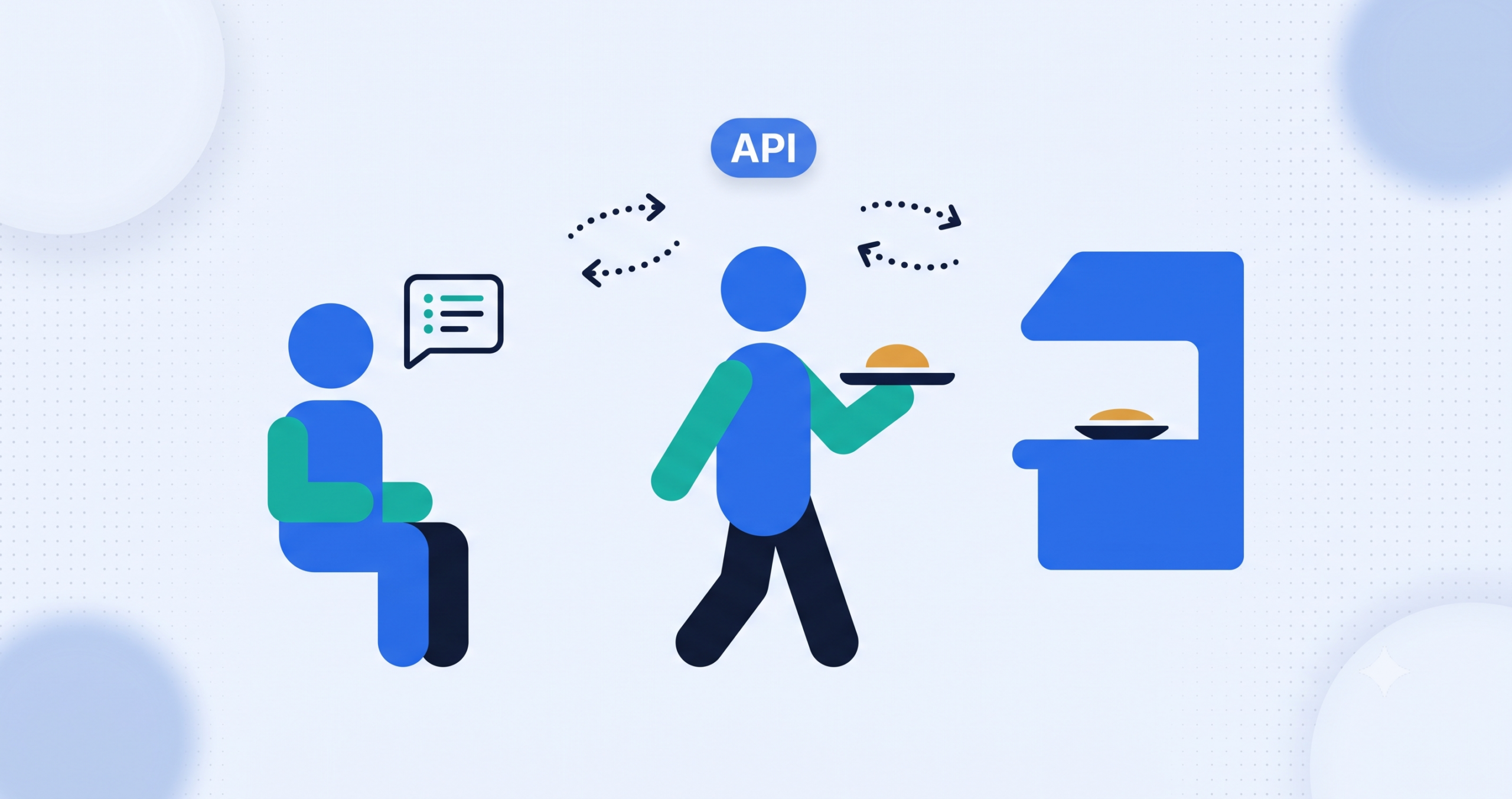
A common way to explain it: think of a restaurant. As a customer, you don’t walk into the kitchen and cook your own food. You tell the waiter what you want, the waiter takes that request to the kitchen, and brings back what you ordered. You never need to know how the kitchen works, only how to order. An API plays the role of the waiter between two pieces of software: one side makes a request, the API carries it to the system that can fulfill it, and carries the response back.
How APIs Work
- Request. An app or website sends a request to an API, asking for specific data or asking it to perform an action, such as “check this user’s order history” or “charge this card.”
- Processing. The API passes that request to the system that can actually handle it, such as a database or a payment processor, without the original app needing to know the details of how that system works.
- Response. The system sends the result back through the API to the app that asked for it, usually as structured data the app can display or act on.
Common Examples of APIs in Everyday Business Tools
- Payment gateways, where a checkout page uses an API to process a card payment without the business building its own payment infrastructure
- Maps and location, where a delivery or booking app shows a live map by calling a mapping API rather than building mapping technology from scratch
- “Sign in with Google” or similar logins, which verify a user’s identity through an API without the business ever storing that password
- Shipping and logistics tracking, where an order status updates automatically by pulling data from a courier’s API
API vs App: What’s the Difference?
| Factor | API | App |
|---|---|---|
| What it is | A set of rules for exchanging data between systems | A complete product a person interacts with directly |
| Who uses it | Other software or developers | End users |
| Visibility | Invisible to the end user | Visible, with screens and buttons |
| Example | A payment gateway’s API | The checkout page itself |
Why APIs Matter for Businesses
- Faster development. Reusing an existing API for payments, maps, or messaging is far faster than building that functionality from scratch.
- Integration. APIs let different tools a business already uses, such as a CRM, accounting software, or inventory system, share data instead of requiring manual re-entry.
- Scalability. A well-designed internal API lets a website, mobile app, and future products all pull from the same backend instead of duplicating logic.
- Automation. Systems that can talk to each other through APIs reduce the manual work of moving data between them.
What Affects the Cost of Building a Custom API
- Number of functions (endpoints) the API needs to support
- Complexity of the underlying business logic behind each function
- Authentication and security requirements, especially for anything handling sensitive data
- Whether it needs to integrate with existing systems, which can add complexity
- Documentation and long-term maintenance, since an undocumented API becomes harder to use over time
Common Mistakes Businesses Make with APIs
- Not planning authentication and security from the start, which is far harder to retrofit later
- Building an API with no documentation, making it difficult for other developers, including future ones, to use it correctly
- Relying entirely on a third-party API with no fallback, leaving the business exposed if that service goes down or changes pricing
- Skipping versioning, so updates to the API break existing integrations without warning
Final Thoughts
An API is not something most business owners need to build themselves, but understanding what one actually does makes it much easier to follow a conversation about integrations, costs, or what a developer means by “we’ll need to build an API for that.”
If a project you’re planning involves connecting systems or building something new, Cospixare Technologies works on custom APIs as part of its custom software development services. Get in touch if that would help.
Frequently Asked Questions
What does API stand for?
Application Programming Interface, a defined way for two pieces of software to exchange data or trigger actions in each other.
Is an API the same thing as an app?
No. An app is the product a person interacts with directly. An API works behind the scenes, letting that app communicate with a server or another system without the user ever seeing it directly.
Do small businesses need custom APIs, or just off-the-shelf tools?
Most small businesses rely on APIs indirectly through the tools they already use, such as payment processors or booking platforms. A custom API tends to become relevant once a business has its own app, website, or systems that need to share data with each other.
What is a REST API?
REST is one common style of designing APIs, based on standard web requests. It is widely used because it is relatively simple to understand and works well over the internet, which is why it’s one of the most common approaches developers reach for.
Are APIs secure?
They can be, if built with proper authentication, access control, and encryption. Security depends entirely on how the API is designed and maintained, not on the fact that it’s an API.
Can an existing website or app be given an API later, or does it need to be built in from the start?
It can usually be added later, though it’s often easier and cleaner if planned from the start. Retrofitting an API onto an existing system depends on how that system was originally built.
Related Reading
Further Reading